What Is Otoplasty?
Surgery to correct the position of the external ear is a common procedure, usually performed under local anesthesia and as an outpatient. Historically there have been numerous techniques put forth to correct the overly protruding ear, most of them requiring cartilage suturing. My preferred technique is one I learned from a famous British plastic surgeon, Ian Muir, with whom I worked for a year in Scotland as a Senior Registrar during my training.
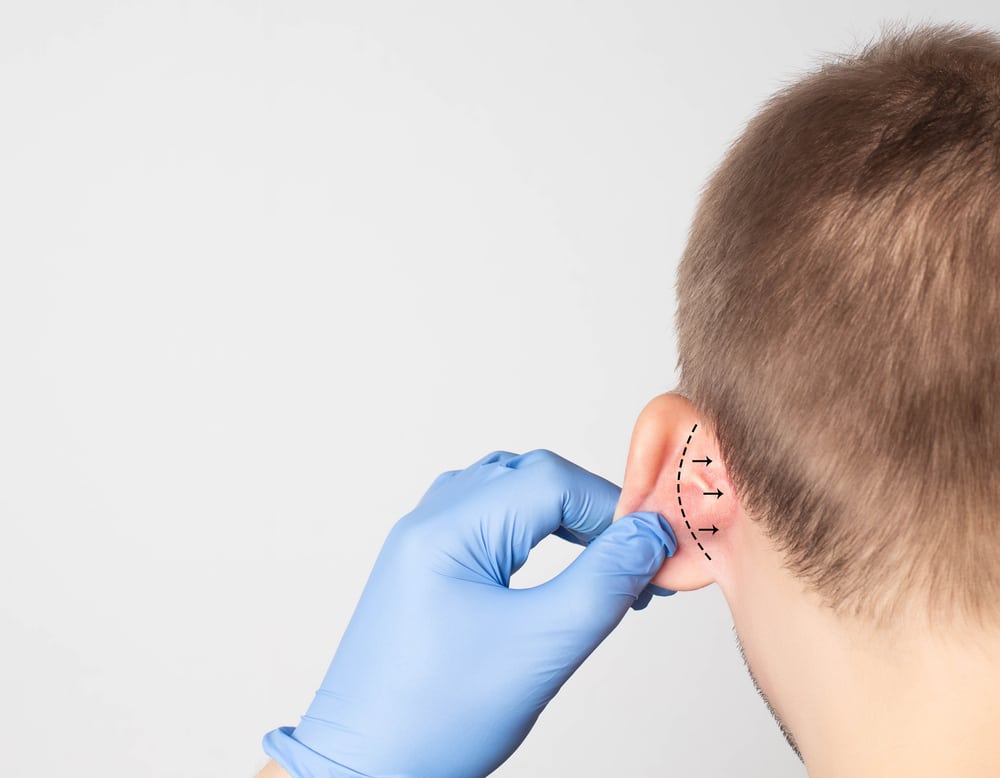
The proposed posterior skin incision is marked on the patient as well as the proposed creation of the antehelix (which is absent) on the anterior skin surgace. Methylene Blue on a 27 gauge needle is used to mark the new prominence of the antehelix. The posterior ear incision is made and exposure of the ear cartilage is followed by incision of the cartilage just distal to the new antehelix. The new curvature of the cartilage is created by scoring of the anterior surface of the cartilage. The tail and superior border of the antehelix is cut with a scissor. Once the cartilage is bent into the proper shape, a posterior crescent skin resection is performed to maintain the new cartilage shape. No cartilage sutures are necessary. A dressing to maintain and protect the ear is placed for 5-7 days.
Cartilage Reshaping And Repositioning
The procedure typically involves an incision placed discreetly behind the ear. Through this approach, cartilage is carefully reshaped, repositioned, or secured with sutures to create a natural contour. The goal is not to “pin” the ears flat against the head, but to achieve balanced projection that aligns with the patient’s facial structure.
In more complex presentations, particularly congenital deformities, advanced reconstructive techniques may be required. Dr. McKinnon’s craniofacial training allows him to evaluate and address these cases with a comprehensive structural approach.
Surgical Planning And Recovery
Successful otoplasty depends on thoughtful preoperative planning. Ear shape, cartilage strength, scalp contour, and facial proportions are all evaluated during consultation. In children, surgery is often considered once ear growth is sufficiently developed, typically around five to six years of age. Adults may pursue correction at any stage provided they are in good overall health.
Anesthesia And Procedure Details
Otoplasty may be performed under local anesthesia with sedation or general anesthesia, depending on the patient’s age and the complexity of the correction. The procedure focuses on preserving natural ear anatomy while improving contour and symmetry.
Recovery Expectations
Initial swelling and mild discomfort are expected and are managed with protective dressings and postoperative guidance. Most patients resume routine activities within a short period, though strenuous activity should be temporarily limited. Final results gradually become more apparent as swelling resolves and tissues settle.
Who Is A Candidate For Otoplasty?
Otoplasty may be appropriate for:
- Children experiencing social distress due to ear prominence
- Adults seeking improved facial balance
- Individuals with congenital ear irregularities
- Patients with asymmetry or post-traumatic deformities
Ideal candidates are in good health and seeking structural refinement grounded in realistic expectations. During consultation, Dr. McKinnon performs a detailed facial assessment to determine whether surgical correction is appropriate and to develop a personalized surgical plan.
Why Choose McKinnon Plastic Surgery For Otoplasty?
Dr. McKay McKinnon is certified by the American Board of Plastic Surgery and has decades of experience in facial and craniofacial surgery. His medical education at The University of North Carolina, postgraduate training on the Harvard Surgical Service, and plastic surgery residency at the University of Miami provide a strong surgical foundation. His craniofacial fellowship with Dr. Paul Tessier in Paris further distinguishes his expertise in structural facial procedures.
Dr. McKinnon has held academic appointments, including Clinical Assistant Professor of Surgery at the University of Chicago, and has been recognized consistently as a Castle Connolly Top Doctor. His experience includes complex craniofacial reconstruction, pediatric facial surgery, and tumor-related facial correction. This depth of surgical training informs every otoplasty procedure, ensuring careful anatomical planning and stable, natural results.
Otoplasty At McKinnon Plastic Surgery In Chicago, IL & Coral Gables, FL
Ear reshaping requires precision, balance, and a detailed understanding of facial anatomy. Patients seeking otoplasty in Chicago, IL and Coral Gables, FL benefit from the experience of a craniofacial-trained surgeon focused on structural integrity and long-term outcomes. To learn more or schedule a consultation, contact McKinnon Plastic Surgery in Chicago at (312) 335-9566 or Coral Gables at (305) 753-1400.